
How to Build a SaaS Product in 60 Days: A Practical Startup Roadmap
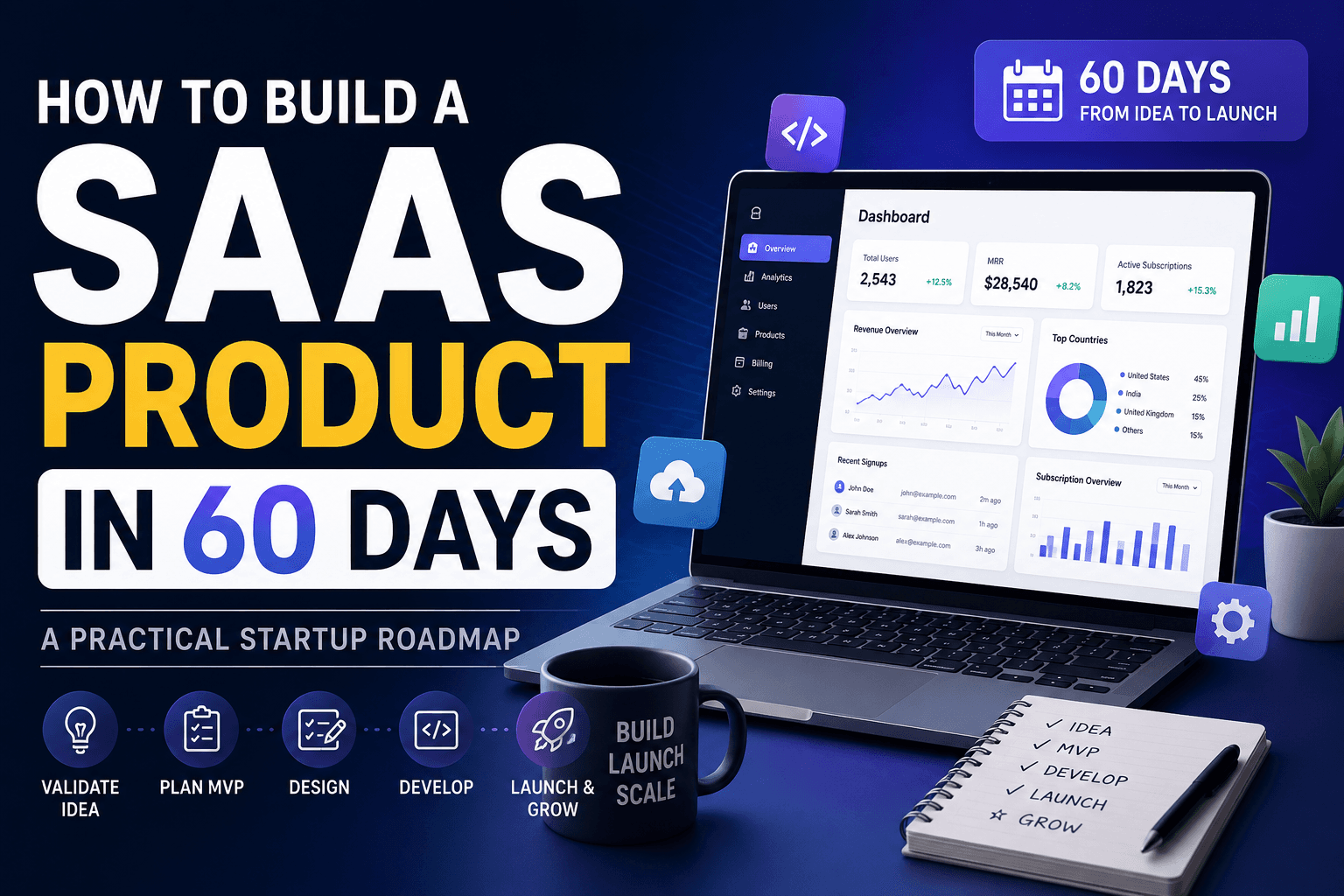
Build, launch, and scale a modern SaaS MVP in just 60 days using lean startup strategies, scalable technologies, effective UI/UX design, and rapid product validation techniques.
Building a SaaS product no longer requires massive engineering teams, years of development cycles, or millions in funding. The modern startup ecosystem has changed dramatically over the last few years. Cloud computing, AI-assisted development, no-code tools, scalable frontend frameworks, and global remote collaboration have significantly reduced the barriers to launching software products.
Today, a focused startup with the right execution strategy can validate an idea, design an MVP, build core functionality, and launch to real users within just 60 days.
The biggest advantage in today’s SaaS industry is speed.
Markets evolve quickly, customer expectations change constantly, and new competitors appear every week. Founders who launch early and improve continuously often outperform businesses that spend years building products in isolation.
Many startups fail because they spend too much time trying to create the “perfect” platform before understanding what customers actually need. They overload products with unnecessary features, ignore validation, or delay launch endlessly.
The smarter strategy is building a lean but scalable MVP that solves one painful problem extremely well.
This guide explains how to build a SaaS product in 60 days using modern development workflows, practical startup strategies, and scalable execution methods.
What Is a SaaS Product?
SaaS stands for Software as a Service.
Unlike traditional software that users install locally, SaaS products operate in the cloud and are accessed through browsers or mobile applications. Users usually pay through monthly or yearly subscriptions, making SaaS one of the most scalable business models in the modern digital economy.
Popular SaaS products include:
CRM platforms
ERP systems
AI productivity tools
Project management software
Accounting platforms
Marketing automation systems
Team collaboration tools
The SaaS business model has become extremely popular because it offers:
Recurring revenue
Easier scalability
Global customer reach
Continuous software updates
Lower maintenance overhead
Faster deployment cycles
However, successful SaaS businesses are not built only with good technology. They succeed because they solve meaningful business problems efficiently.
Can You Really Build a SaaS Product in 60 Days?
Yes — but only if you focus on building an MVP.
An MVP (Minimum Viable Product) is the simplest version of your product capable of solving one core problem effectively. Instead of building a massive enterprise-level platform immediately, you focus only on the features necessary to deliver value.
The purpose of a 60-day SaaS launch is not perfection.
The real goal is to:
Validate demand
Acquire early adopters
Gather feedback
Improve rapidly
Create initial traction
Trying to build a feature-heavy platform in two months is unrealistic.
But building a focused, scalable, production-ready MVP is absolutely achievable with disciplined execution.
Phase 1: Days 1–7 — Validate the Idea
The first week is one of the most important stages in SaaS development.
Most SaaS startups fail because they spend months building products nobody truly needs. Great design and powerful engineering are useless if the product does not solve a meaningful problem.
Before writing code, validate the market.
Identify a Real Pain Point
Strong SaaS products typically solve:
Repetitive workflows
Time-consuming manual tasks
Communication inefficiencies
Data management issues
Expensive operational processes
Team collaboration problems
Avoid creating generic products for broad audiences.
Instead of building “software for everyone,” focus on a clearly defined niche.
For example:
CRM software for small real estate agencies
AI workflow automation for marketing teams
Scheduling systems for coaching businesses
Inventory dashboards for local retailers
Specificity improves positioning, marketing, and customer acquisition.
Talk to Potential Users
Direct conversations with potential users provide insights that analytics dashboards cannot.
Ask practical questions such as:
What is your biggest operational challenge?
Which tools are you currently using?
What frustrates you most?
How are you solving the problem today?
Have you paid for solutions before?
Your goal is understanding real behavior — not collecting compliments.
If businesses are already spending money to solve the problem, it is usually a strong validation signal.
Analyze Competitors
Research competing SaaS products carefully.
Study:
Features
Pricing models
User reviews
UI/UX quality
Customer complaints
Missing capabilities
The goal is not copying competitors.
The goal is identifying gaps and opportunities where your product can provide a better experience, simpler workflow, or stronger positioning.
Phase 2: Days 8–14 — Plan the MVP
Once validation is complete, define your MVP clearly.
Feature overload destroys startup timelines.
Your SaaS product should focus on one primary outcome.
Examples include:
Automating invoice generation
Simplifying customer management
Centralizing communication workflows
Managing social media scheduling
Every feature should support this core objective.
Prioritize Features Properly
Separate features into categories.
Must-Have Features
These are essential for launch:
Authentication
Dashboard
Core functionality
Database integration
Billing system
User settings
Future Features
These can wait until after launch:
AI automation
Advanced analytics
API integrations
Team collaboration systems
Enterprise controls
Lean products launch faster and gather feedback sooner.
Phase 3: Days 15–25 — Design the Product
Design plays a major role in SaaS success.
Users judge software almost instantly. A confusing interface reduces trust, increases churn, and damages adoption rates.
Good SaaS design improves:
User retention
Customer trust
Conversion rates
Onboarding speed
Overall usability
Even powerful software can fail if users feel overwhelmed.
Focus on User Experience First
Before designing visual elements, map the product workflow.
Plan:
User journeys
Navigation structure
Dashboard layout
Common user actions
Onboarding flows
Your product should feel intuitive from the first interaction.
Users should understand the platform without extensive tutorials.
Keep the Interface Clean
Modern SaaS users prefer fast, minimal, and responsive interfaces.
Good SaaS UI design includes:
Clear typography
Consistent spacing
Simple navigation
Fast-loading pages
Mobile responsiveness
Minimal distractions
Clean interfaces usually outperform feature-heavy dashboards.
Phase 4: Days 26–45 — Develop the MVP
This is the core execution phase.
A successful 60-day SaaS launch requires disciplined development, efficient communication, and clear priorities.
At this stage, the goal is not perfection.
The goal is creating a stable, scalable, and functional product.
Choosing the Right Tech Stack
Your technology stack affects:
Development speed
Scalability
Security
Performance
Long-term maintenance
A modern SaaS stack may include:
Frontend
React
Next.js
TypeScript
Backend
Node.js
Express
NestJS
Database
PostgreSQL
MySQL
Cloud Infrastructure
AWS
Google Cloud
Vercel
Payments
Stripe
Razorpay
The best tech stack is not always the most advanced one.
It is the stack your team can execute efficiently.
Build Core Features First
Develop in this order:
Authentication
Database architecture
Core workflow
Dashboard system
Billing functionality
Notifications
Settings and permissions
This structure prevents unnecessary complexity.
Prioritize Security Early
Security is essential for SaaS credibility.
Basic SaaS security includes:
HTTPS encryption
Secure authentication
Password hashing
API protection
Access controls
Database backups
Users trust SaaS platforms with sensitive business information.
Security should never be treated as optional.
Optimize Performance
Slow software reduces retention and increases churn.
Focus on:
Fast API responses
Optimized database queries
CDN usage
Image optimization
Caching systems
Performance directly impacts user experience and SEO rankings.
Phase 5: Days 46–52 — Testing & QA
Testing is one of the most overlooked phases in SaaS development.
Even small bugs can reduce trust and damage user experience.
Before launch, test:
Authentication systems
Payments
Dashboard workflows
Mobile responsiveness
Notifications
User permissions
Use real-world testing scenarios whenever possible.
Beta Testing
Invite a small group of early users to test the product.
They will identify:
Confusing workflows
Missing functionality
UI issues
Performance problems
Onboarding friction
Early feedback improves product quality significantly before public launch.
Phase 6: Days 53–57 — Pricing & Marketing
Even great SaaS products fail without visibility.
Building software is only half the challenge.
Acquiring users consistently is equally important.
Choose a Pricing Model
Popular SaaS pricing models include:
Freemium
Subscription-based
Usage-based pricing
Tiered pricing
Keep pricing simple initially.
Complicated pricing structures often reduce conversions.
Build a High-Converting Landing Page
Your landing page should clearly explain:
What the product does
Who it is for
Key benefits
Pricing
CTA buttons
Focus on outcomes rather than technical jargon.
Instead of saying:
“AI-powered workflow orchestration.”
Say:
“Automate repetitive tasks and save hours every week.”
Clarity converts better.
Start Marketing Before Launch
Generate early traction through:
SEO blogs
LinkedIn content
Founder branding
Startup communities
Email waitlists
Cold outreach
Marketing should begin before launch — not after it.
Phase 7: Days 58–60 — Launch the Product
Your launch does not need to be perfect.
It needs to feel stable, polished, and valuable.
Many successful SaaS companies improved dramatically after their initial launch.
The biggest mistake founders make is delaying release endlessly.
Launch quickly.
Improve continuously.
What to Track After Launch
Monitor important metrics such as:
User signups
Retention rates
Churn
Revenue growth
Conversion rates
Customer feedback
These metrics reveal where your SaaS product needs improvement.
Common SaaS Mistakes to Avoid
Overbuilding Features
Too many features delay launches and increase complexity.
Focus on solving one problem exceptionally well.
Ignoring User Feedback
Real users reveal what actually matters.
Listen carefully and iterate rapidly.
Weak UI/UX
Even powerful software fails if users feel confused.
Usability directly impacts growth.
No Marketing Strategy
A strong product without visibility will struggle.
Distribution is just as important as development.
How AI Is Accelerating SaaS Development
AI is dramatically reducing SaaS development timelines.
Modern teams now use AI for:
Code generation
UI prototyping
Documentation
Automated testing
Customer support
This allows startups to launch faster with smaller teams.
However, AI should enhance product quality — not replace strategic thinking.
The strongest SaaS products combine:
Clean UX
Reliable engineering
Smart automation
Strong positioning
Final Thoughts
Building a SaaS product in 60 days is completely achievable when the process is structured correctly.
The most successful founders focus on:
Real business problems
Lean execution
Fast iteration
User feedback
Scalable architecture
Do not wait for perfection.
Most successful SaaS companies evolved significantly after launch.
A focused MVP launched today is far more valuable than a “perfect” product delayed for another year.
Start small.
Launch fast.
Improve continuously.
That is how modern SaaS businesses are built.